The 20% Rule is Dead: 5 Surprising Truths About Buying a Home in 2026
1. Introduction: The Great Mortgage Misconception
For many aspiring homeowners, the dream of property ownership feels perpetually anchored by a psychological threshold: the belief that a massive mountain of liquid capital is required to even enter the arena. This sense of being "priced out" is a common form of transactional friction, fueled by the outdated dogma of the 20% down payment. However, current lending data reveals that the most significant barrier to entry is often a persistent myth rather than a literal lack of funds.
As we navigate the 2026 market climate, success is less about sheer savings and more about strategic math. By distilling the most impactful shifts in modern lending, we can reveal a path to homeownership that prioritizes financial agility over traditional cash hoarding.
2. Takeaway 1: You Probably Don't Need 20% (In Fact, You Might Need 0%)
The long-standing advice to save 20% before engaging with the market is no longer the industry standard. While a 20% allocation allows a buyer to bypass Private Mortgage Insurance (PMI), modern buyers are increasingly choosing to leverage lower entry points to preserve their liquid assets in a post-inflationary economy.
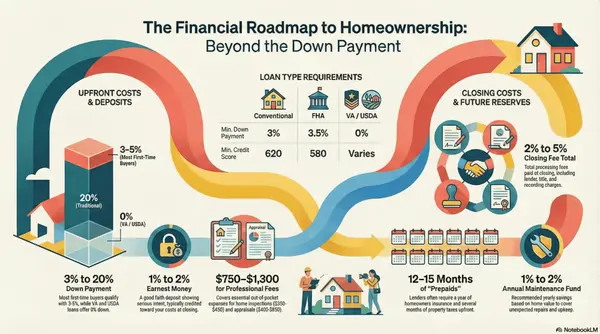
By utilizing low-down-payment vehicles, buyers can drastically compress their "saving" timeline, often moving into a home years ahead of schedule. Current minimum requirements for 2026 include:
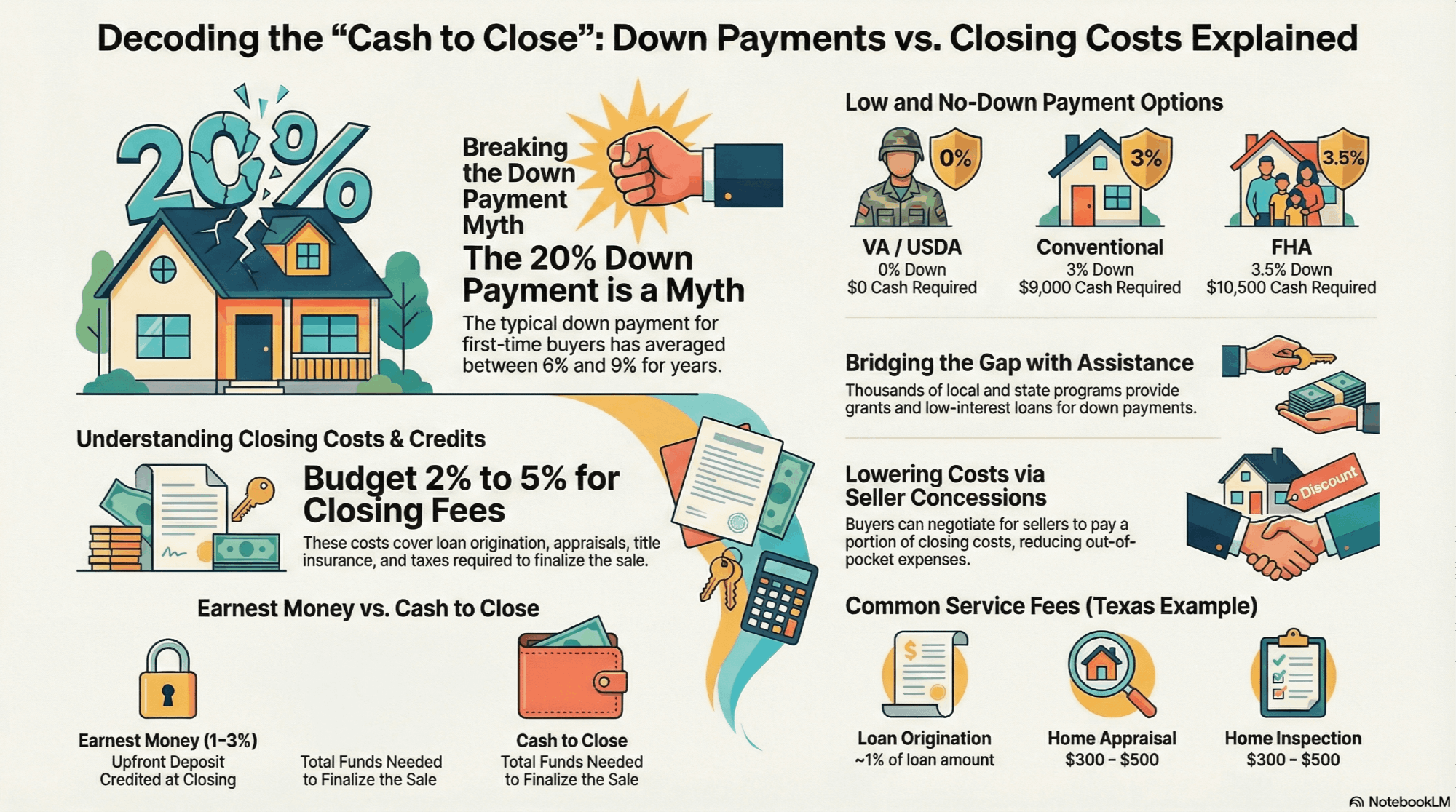
- Conventional Loans: As low as 3%
- FHA Loans: 3.5%
- VA and USDA Loans: 0% for eligible service members and rural locations
As Evergreen Home Loans notes, the reality of the market has long deviated from the 20% myth:
"The typical down payment for first-time buyers has been between 6% and 9% for years."
3. Takeaway 2: Down Payments and Closing Costs Are Not the Same Thing
A critical point of confusion that often blindsides novice buyers is the distinction between the down payment and the total "Cash to Close." To navigate this successfully, you must view the down payment as an investment in equity—the portion of the purchase price that reduces your loan balance—while closing costs represent the transactional friction paid to third parties to facilitate the deal.
While you may have your 3.5% down payment ready, you must also account for an additional 2% to 5% (and in some high-cost regions, up to 6%) in fees. These include loan origination fees—typically ranging from 0.5% to 1% of the loan amount—as well as title searches and government recording fees.
Redfin emphasizes this vital separation:
"Your down payment is not included in your closing costs; they’re two separate expenses you pay during the homebuying process."
4. Takeaway 3: The "Seller Concession" Strategy (Leveraging the Transaction)
If the prospect of paying both a down payment and 5% in closing costs creates too much "cash-at-closing" friction, sophisticated buyers utilize Seller Concessions. This strategy effectively allows a buyer to leverage the loan to cover upfront transaction costs. By offering a slightly higher purchase price in exchange for the seller paying the buyer’s closing costs, you can keep more liquid capital in your pocket.
Consider the strategic math between Joe Buyer and Sally Seller:
|
Offer Type |
Sales Price |
Seller Concession |
Net to Seller |
Upfront Cash Required |
|
Standard Offer |
$297,000 |
$0 |
$297,000 |
Higher |
|
Concession Offer |
$300,000 |
$3,000 |
$297,000 |
$3,000 Lower |
In the Concession Offer, Sally’s bottom line remains identical, making her neutral to the structure. Joe, however, brings $3,000 less to the closing table. The trade-off is a minor increase in the monthly mortgage payment due to the slightly larger loan balance—a strategic move that many 2026 buyers find preferable to exhausting their savings.
5. Takeaway 4: Texas-Sized Closing Costs and Local Nuances
Geographic location dictates the severity of closing costs. In Texas, for instance, these costs are traditionally the buyer’s responsibility and frequently trend toward the higher end of the scale (up to 6%). This is where "insider" knowledge becomes essential: while certain fees are customary, every element of a real estate contract is negotiable.
Texas buyers should specifically prepare for the "Big Three" fees that often catch the uninitiated off guard:
- Land Survey Fees: Starting at $250 to verify legal property boundaries.
- Title Insurance: Often ranging from 200–250 to protect against ownership disputes.
- Appraisal Fees: Typically 300–500 for a professional assessment of the home’s market value.
Understanding that these are standard in the Lone Star State allows you to negotiate other areas of the contract with greater precision.
6. Takeaway 5: Assistance is "At a Glance" If You Know Where to Look
Down Payment Assistance (DPA) is one of the most underutilized tools in a buyer’s arsenal. In Texas, the Department of Housing and Community Affairs (TDHCA) provides robust support that isn't just for first-time buyers. While the "My First Texas Home" program is geared toward those who haven't had ownership interest in a primary residence within the past three years, the "My Choice Texas Home" program offers up to 5% assistance even for repeat buyers.
Quick Look: TDHCA Program Eligibility
- Minimum FICO Score: 620
- Assistance Amount: Up to 5% for down payments and closing costs.
- Property Flexibility: Eligible properties include single-family residences, duplexes (provided one side is owner-occupied), FHA-approved condos, and even manufactured homes.
7. Conclusion: The Path Forward
The housing landscape of 2026 confirms that the gate to homeownership is no longer locked by a 20% key. Instead, the "strategic math" of low-down-payment loans, seller concessions, and state-sponsored assistance has transformed the market. By understanding the distinction between equity and transaction costs, and leveraging local nuances, the barrier to entry effectively dissolves.
If the 20% barrier is gone, what is truly holding you back from holding your new set of keys this year?
Categories